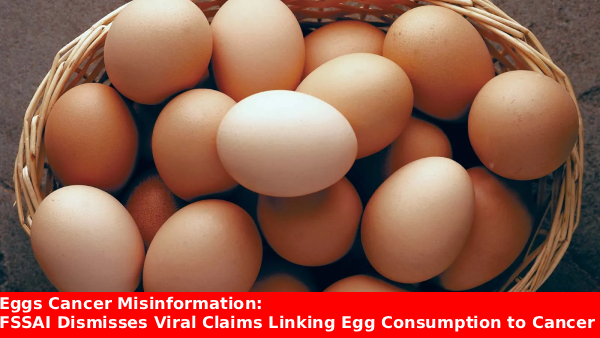
Eggs cancer misinformation spread across social media has prompted India’s food regulator, the Food Safety and Standards Authority of India (FSSAI), to issue a strong clarification. The authority has categorically stated that eggs sold and consumed in India are safe, nutritious, and not linked to cancer, urging the public to rely on verified scientific evidence rather than viral claims.
Eggs Cancer Misinformation Sparks Public Concern
Over recent weeks, multiple social media posts alleged that eggs available in Indian markets contain nitrofuran metabolites (AOZ)—chemical residues falsely claimed to be cancer-causing. These posts led to confusion and alarm among consumers, with many questioning the safety of daily egg consumption.
Addressing the issue, FSSAI termed these claims as “misleading, scientifically unsupported, and capable of creating unnecessary public panic.”
FSSAI Clarification on Nitrofuran Residues
FSSAI officials clarified that the use of nitrofurans is strictly prohibited at all stages of poultry and egg production under the Food Safety and Standards (Contaminants, Toxins and Residues) Regulations, 2011.
What Does EMRL Really Mean?
An Extraneous Maximum Residue Limit (EMRL) of 1.0 µg/kg has been set for nitrofuran metabolites, including AOZ. However, FSSAI explained that this limit is only for regulatory enforcement and represents the lowest detectable level using advanced lab techniques.
Detection of trace residues below this level does not indicate food safety violations or health risks.
No Scientific Evidence Linking Eggs to Cancer
Reinforcing the regulator’s stance, medical experts dismissed the eggs cancer misinformation circulating online.
Expert Opinion
Dr Meghal Sanghavi, Oncosurgeon at Wockhardt Hospitals, Mumbai Central, stated:
“Large scientific studies have not shown any direct link between egg consumption and cancer. Cancer risk is far more influenced by lifestyle factors like tobacco use, alcohol intake, obesity, and physical inactivity.”
He also highlighted that fear surrounding cancer makes people vulnerable to misinformation that unfairly targets single foods.
Are Eggs Safe for Daily Consumption?
According to Dt Amreen Sheikh, Chief Dietitian at KIMS Hospitals, Thane, eggs are safe for most people when consumed in moderation.
Nutritional Value of Eggs
Eggs provide:
-
High-quality protein
-
Essential amino acids
-
Vitamin B12
-
Choline
-
Antioxidants like lutein
“Most dietary guidelines allow one egg per day as part of a balanced diet, unless restricted due to specific medical conditions,” Sheikh explained.
What Consumers Should Remember
Both experts and regulators emphasised that:
-
No single food causes or prevents cancer
-
Balanced diet and healthy lifestyle matter more
-
Viral claims should not replace medical advice
FSSAI reiterated that eggs remain a safe and valuable dietary component when sourced and cooked properly.
Conclusion
The recent wave of eggs cancer misinformation highlights the dangers of unverified health claims on social media. FSSAI and medical experts urge consumers to trust science-backed evidence and official advisories, confirming that normal egg consumption poses no cancer risk.