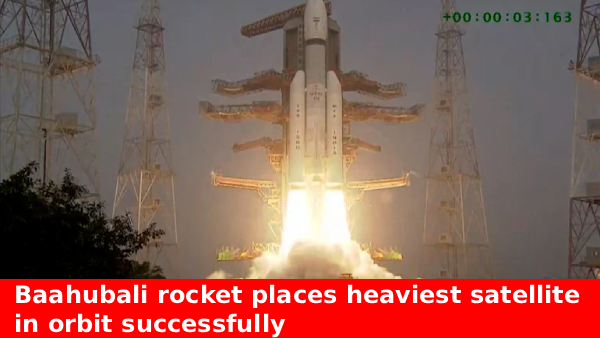
In a landmark achievement for India’s space programme, Baahubali rocket places heaviest satellite in orbit as ISRO’s Launch Vehicle Mark-3 (LVM3-M6) successfully deployed the BlueBird 6 communication satellite into orbit. The mission marks India’s growing role in global commercial satellite launches and advances space-based broadband connectivity.
Baahubali rocket places heaviest satellite in orbit during landmark ISRO mission
India’s powerful launch vehicle, fondly called the ‘Baahubali rocket’, lifted off from the Satish Dhawan Space Centre in Sriharikota at 8:55 am, carrying BlueBird 6 — a next-generation communications satellite developed by US-based AST SpaceMobile. Standing 43.5 metres tall and equipped with two S200 solid boosters, the rocket delivered the heaviest payload ever launched from Indian soil.
After a smooth 15-minute flight, the satellite separated successfully at an altitude of around 520 km, entering its intended orbit with precision.
ISRO confirms Baahubali rocket places heaviest satellite in orbit
ISRO Chairman Dr. V. Narayanan confirmed that the Baahubali rocket places heaviest satellite in orbit, calling it one of the finest performances of the LVM3 vehicle. This marks the third fully commercial mission for LVM3, further cementing India’s reputation as a reliable heavy-lift launch provider.
Prime Minister Narendra Modi hailed the achievement as a “significant stride” for India’s space sector, highlighting its importance in strengthening India’s presence in the global launch market.
Mission Highlight
-
Satellite: BlueBird 6 (Block-2 series)
-
Purpose: Direct-to-smartphone broadband connectivity
-
Launch Vehicle: LVM3-M6 (Baahubali rocket)
-
Orbit Altitude: ~520 km
-
Launch Partner: NewSpace India Ltd & AST SpaceMobile
Launch Delay for Safety
The launch time was adjusted by 90 seconds to avoid potential collision risk with orbiting debris — a precautionary step reflecting global best practices in satellite safety.
About the LVM3 ‘Baahubali’ Rocket
The LVM3 is a three-stage heavy-lift vehicle capable of carrying 4,200 kg to GTO. It has previously powered key missions such as Chandrayaan-2, Chandrayaan-3, and OneWeb satellite launches.
Conclusion
With the Baahubali rocket placing the heaviest satellite in orbit, India continues to expand its technological capabilities while playing an increasingly pivotal role in commercial space ventures — and bringing the promise of space-based mobile broadband closer to reality.